
Free Inquiry #5
For this lesson, I thought I would write more a reflection that would be a precursor to using the compass. This is based off a lesson that we had in Teaching Physical Education and Health that combines P.E and Language Arts (french).
For the first activity, the class is divided into small teams (3-4 people). To prepare, the teacher needs to pick an area outside by the school hide cards with words (that are all part of a phrase). The objective for each team is to find each card, and write down each word that they find on their team piece of paper – which becomes sort of like a word-phrase anagram.
Once each team believes that they have the full phrase with each word in place, the final clue is revealed. The game ends once each team finds all the words and discovers the final clue.
The phrase could say, for example: “in order to win the game, look under the flower pot at the start”
Or something along the same idea. This is a good game for teamwork, literacy skills, and running around.
The second activity is about following visual instructions. Each student picks a partner and each partner has the same card each round (so, one card each that are the same).
With cones set up 5 by 5, the partner who moves has to navigate around the cones. The partner who watches will let them know if they’ve made a mistake or have taken a wrong turn. If the moving student does so, they have to restart. Once the moving student completes the path correctly, they switch roles.
Here is an image example:
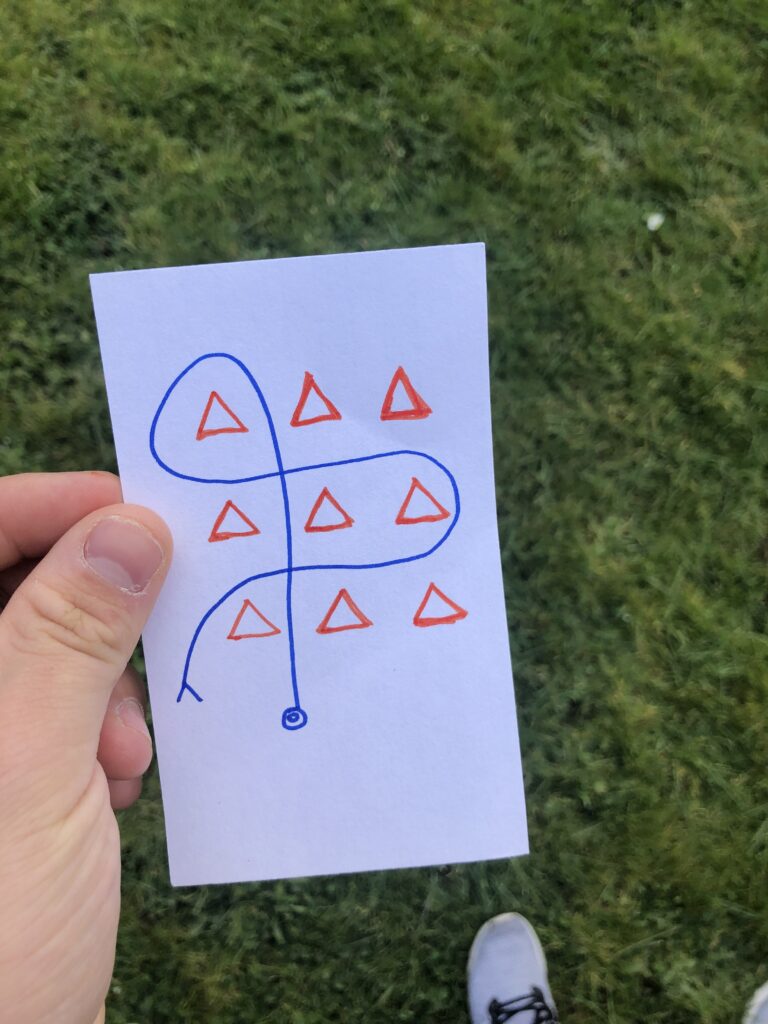
Another variation of this game is that the mover does not have a card, and the observer has to communicate the path to the mover without speaking. They can make sounds or use hand gestures from the sidelines.
This activity is good for communication skills, navigation, and team-work as well.
Here’s a website that will be super useful for me with resources for when I start my practicum!
navigationgames.org/ngactivities/curricula/run-a-school-based-activity
Good activity. I like that you vary the environment, communication options, and the team challenge approach. Thanks for sharing.